

The workday rarely ends cleanly when the office is also your house. Without a deliberate stop, the laptop stays half-open, the phone keeps buzzing, and dinner becomes another place where work thoughts interrupt. A short, repeatable shutdown routine is one of the highest-leverage habits I have found for protecting family time.
I am Dan Whitaker. I live in Raleigh with Sarah, Maya, and Ethan. I work in IT and security operations for a remote-first company. I have tested longer shutdown rituals and complicated productivity systems. The ones that stick are short enough to do even on a tired day. Fifteen minutes is enough.
Why a Hard Stop Matters
When work and home share the same space, the brain needs a clear signal that one mode is ending and another is beginning. Without that signal, “just one more check” becomes a habit that erodes evenings. Kids notice. Partners notice. Eventually you notice that the day never really finished.
I used to keep the laptop open on the kitchen counter “just in case.” The result was that work thoughts followed me into every conversation. Closing the machine and moving it to a charging spot away from the living area made a bigger difference than any app setting I had tried. The physical act of closing the lid became the signal my brain needed.
The Core 15-Minute Sequence
Close or archive the active work tabs and files.
Write tomorrow’s top three priorities in one place.
Scan for any message that truly cannot wait until morning.
Set devices to the evening state (Do Not Disturb, work apps closed or logged out).
Physically leave the work area if possible, even if it is only moving to another room.
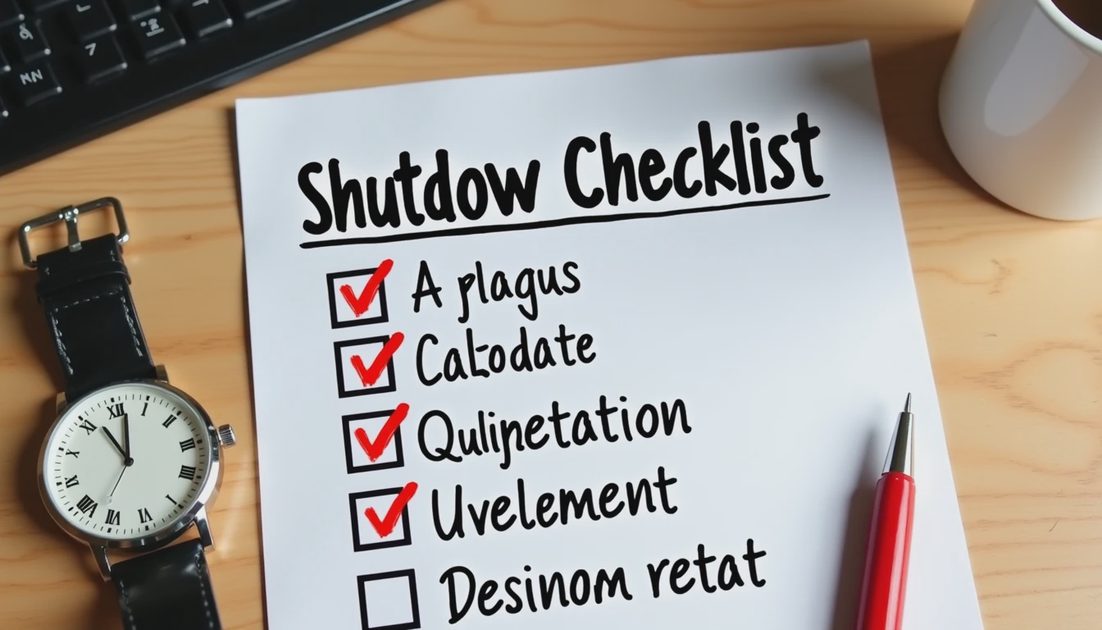
This sequence is deliberately short. It is not a full review of the day. It is a clean handoff from work mode to home mode. I keep a printed version of these five steps near the desk so I do not have to remember them when I am already tired.
Making It Survive Real Life
The routine only works if it survives the days when you are tired, behind, or interrupted. I keep it visible as a short checklist near the desk. On hard days I still do the minimum version: close the laptop, write the three priorities, silence the phone. Something is better than nothing.
Common Failure Points and Fixes
Failure Point | What Usually Happens | Simple Fix |
|---|---|---|
“Just one more email” | Evening starts 30 minutes late | Hard time limit on the final check |
Kids interrupt | Routine gets abandoned | Involve them in the “work is done” signal |
Working from the couch | No physical separation | Move the laptop to a charging spot away from living areas |
High-urgency role | Fear of missing something | Define what truly counts as urgent after hours |
Exhaustion | Skip the whole thing | Do the 3-minute minimum version |
The table is based on patterns I have seen in my own house and in conversations with other remote parents. The fixes stay light on purpose. Complicated systems fail on the exact days you need them most.
What Changes After a Few Weeks
People who stick with a short shutdown routine often report that evenings feel less mental. The work thoughts still appear, but they have a container. The laptop is closed. The phone is quieter. Dinner is more likely to stay dinner. The gain is not dramatic productivity. The gain is a clearer line between the workday and the rest of life.
The routine is not about perfection. Some evenings the checklist gets interrupted by a child who needs help or a call that truly cannot wait. On those days I still do the minimum. The signal to the brain is what matters. Over time the short ritual becomes automatic, and the evenings feel less like an extension of the workday.
I have shared this sequence with other remote parents. The ones who treat it as a non-negotiable block report the biggest change. The ones who treat it as optional tend to skip it on the exact days they need it most. Consistency beats intensity here.
Made simple. Fifteen minutes is enough to tell your brain the workday is over. Less hassle. More life.

One More Practical Detail
I keep the shutdown checklist on a small card taped near the power outlet where the laptop charges at night. Seeing the card is often enough to trigger the routine even when I am already thinking about dinner. The environment does part of the work so willpower does not have to do all of it.
That small environmental cue has made the difference between “I meant to shut down properly” and actually doing it on ordinary weeknights. The card also serves as a quiet reminder to anyone else in the house that the workday has a visible end point.
The routine is not about perfection. Some evenings the checklist gets interrupted by a child who needs help or a call that truly cannot wait. On those days I still do the minimum: close the laptop, write the three priorities, silence the phone. The signal to the brain is what matters. Over time the short ritual becomes automatic, and the evenings feel less like an extension of the workday.
I keep the checklist on a small card near the power outlet where the laptop charges at night. Seeing the card is often enough to trigger the routine even when I am already thinking about dinner. The environment does part of the work so willpower does not have to do all of it.
Made simple. Fifteen minutes is enough to tell your brain the workday is over. Less hassle. More life.