

I run three or four times a week, usually three to five miles. It is not training for a race. It is the clearest boundary I have between work mode and the rest of life. While I am moving, the phone stays on a shelf in the house and the open loops have to wait. By the time I get back, many of them have settled on their own.
I am Dan Whitaker. I live in Raleigh with Sarah, Maya, and Ethan. I work as an IT & Security Operations lead at a remote-first company. The run started as a way to clear my head. It became a weekly proof that a short, physical boundary can protect attention more reliably than a long list of digital rules.
What the Run Actually Protects
Here is the part that usually causes trouble: most boundary advice stays digital. Turn off notifications. Use Do Not Disturb. Set an auto-reply. Those tools help, but they are invisible and easy to override. A run is physical and time-bounded. The phone is not in my pocket. The household knows I am unavailable for that window. The consistency removes the need to renegotiate every time.
What I Leave Behind
The phone stays on the same shelf by the door.
The laptop is already closed from the end of the workday.
No earbuds with work email or chat.
The route is short enough that it fits ordinary weekdays.
The return is predictable, so the household can plan around it.
None of these steps require special equipment. They require treating the run as a real boundary instead of optional exercise that can be interrupted.
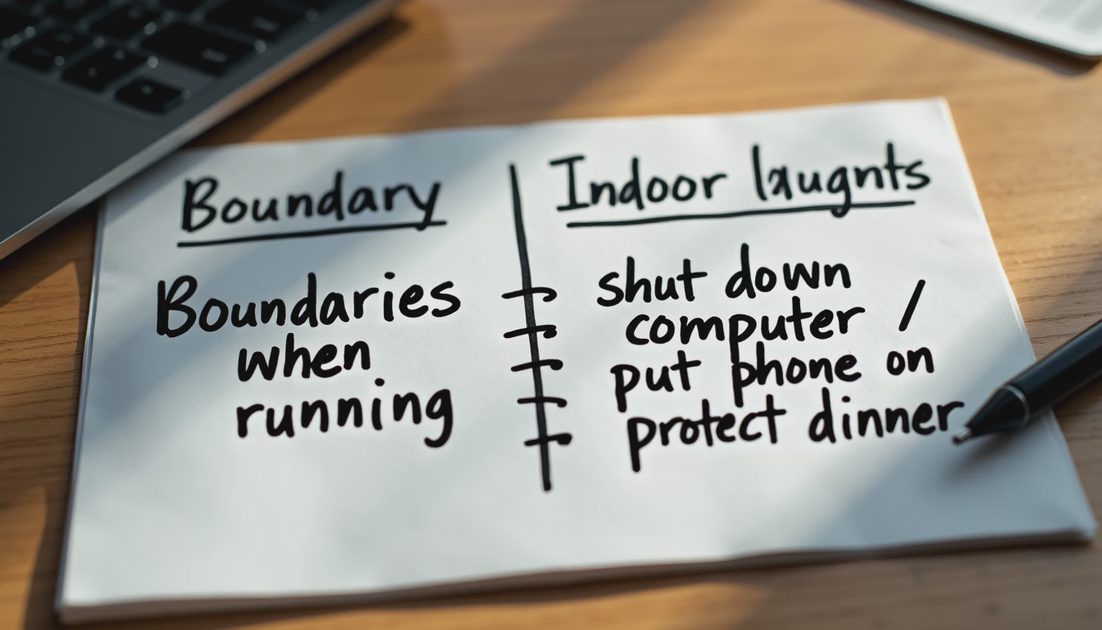
How the Lesson Moved Indoors
The same principle transferred to the rest of the day. If a forty-minute physical boundary can protect attention that reliably, smaller digital boundaries can do the same. Closing the laptop and moving it to a charging spot is the indoor version of leaving the phone on the shelf. Putting the phone outside the kitchen during dinner is the same idea at a shorter scale.
Boundary Comparison
Run Boundary | Indoor Equivalent | Shared Quality |
|---|---|---|
Phone left on shelf | Phone on charging shelf at dinner | Physical distance |
Fixed start time | Consistent shutdown time | Predictability |
No work audio | Notifications off | No incoming work signals |
Household knows the window | Household sees the closed laptop | Visible to others |
Short enough to keep | Short enough to keep on tired days | Sustainable length |
The table is not a complete system. It is a translation of one working boundary into daily life.
Why Short and Visible Beats Elaborate
Elaborate digital rules tend to erode on hard days. A short physical boundary is harder to negotiate away. I do not treat the run as optimization. I treat it as proof that the world does not collapse when I am briefly unreachable. That proof makes the smaller boundaries around the laptop and the phone easier to defend.
Made simple. A clear boundary, even a short one, does more than a long list of intentions. Less hassle. More life.

The run also taught me that the boundary works better when it is consistent and visible. I leave the phone in the same place every time. The household knows the window without a conversation. That predictability is what digital rules often lack—they stay private and can be toggled without anyone noticing.
I still skip the run on some weeks when travel or illness intervenes. The difference is that the boundary has a clear shape I can return to. I do not have to invent a new system every time life gets messy. The shelf, the closed laptop, and the short route are already defined.
Parents who work from home often tell me they feel guilty taking time that is only for themselves. The run reframed that for me. The forty minutes offline make the remaining work hours more focused and the evenings less contaminated by residual attention. The household benefits from the boundary even when the run is only mine.
If a physical boundary feels unavailable, start smaller. A ten-minute walk with the phone left behind is still a proof of concept. The point is not the mileage. The point is the unreachable window and the return to a house that did not require constant availability.
The lesson I keep is simple. Boundaries that depend only on willpower and hidden settings erode. Boundaries that are physical, visible, and short enough to keep on ordinary days tend to hold. The run was never about fitness metrics. It was about proving that attention can have a protected edge.
Made simple still applies. The boundary that works is the one you can keep when the week is ordinary, not the one that only works when life is calm.